

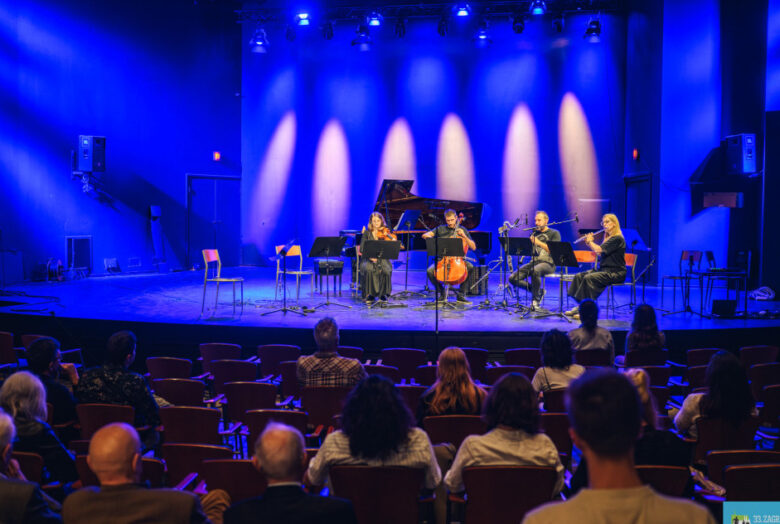
The new concert season of the Cantus Ensemble in Lisinski Hall’s Small Hall began with an international exchange. Visiting from Warsaw was the Polish Hashtag Ensemble, while Cantus will soon return the visit in just a few days’ time.
The extensive concert booklet informs us that the program features works by six internationally recognized composers whose music demonstrates sonic courage and engages, through its musical language, with pressing social issues — above all, ecological ones whose worrisome consequences we are reminded of almost daily.
Polish–Croatian Musical Ties
This exchange between the two ensembles renews and strengthens musical ties that have existed since the previous century — particularly those between the Warsaw Autumn Festival and the Zagreb Music Biennale. The initiative came from the tireless artistic director of Cantus Ensemble, Berislav Šipuš, during his recent visit to Warsaw Autumn — a festival that in earlier years hosted Kelemen, and later Malec and Detoni.
Conversely, works by Polish composers have also appeared at the Biennale, with particular emphasis on Krzysztof Penderecki, a frequent Zagreb guest whom the city almost “adopted.” Penderecki even appeared as a conductor, while memorable visits from Zygmunt Krauze — especially in his dual role as composer-pianist — further deepened those connections.
A Glimpse Through the Keyhole
Before a small audience in the Small Hall of Lisinski — a reminder, perhaps, of a somewhat complacent musical environment, and a reflection of the general decline in musical curiosity amid the erosion of taste across genres — a younger generation of internationally active composers presented their works.
The program also included a composition by Croatian composer Margareta Ferek-Petrić, a gesture that, though increasingly rare, signals a commendable awareness of and respect for the milieu in which guest artists perform.
Sensitivity to Contemporary Issues
A single concert, like a glance through a keyhole, can offer only a partial view of contemporary Polish musical creativity. Yet the program revealed a keen sensitivity to current issues — and a degree of personal engagement with the world around us.
Particularly striking was the attention to climate change, a theme that troubles our planet and every sensitive being who inhabits it — unless, of course, one is too preoccupied with sheer survival to reflect, or unwilling to rise above the prevailing life philosophy popularly reduced to the self-centered maxim: “for me, on me, under me.”
Importantly, one sensed that this ecological concern was no mere fashion or opportunistic bid for relevance, but a sincere artistic engagement.
Sound Worlds of Resistance and Reflection
The intriguing and stimulating concert — whose works often incorporated electronic media — opened with Paweł Malinowski’s Paradise Blue (We’d Never Be Apart) for bass clarinet, accordion, and electronics. Here, the electronic component alternates between intervening and dialoguing on equal terms, creating a tenderly tinted yet lively trio texture. Malinowski writes that “the simplest, most naïve collective actions can become rituals against the fatigue of capitalist realism” — and thus acts of resistance.
Angélica Negrón’s Dust, for flute, clarinet, violin, cello, and recorded electronics, vividly evokes a frozen wasteland after catastrophe — only to let a spark of hope emerge at the end.
In Climate Burn-Out for flute, clarinet, cello, and piano — the second part of her Stress Trilogy — Margareta Ferek-Petrić deploys an imaginative, restless flow of motion and abrupt transformations, framed by quotations from Nietzsche’s Thus Spoke Zarathustra.
The Allure of the Electromagnetic
Aleksandra Kaca’s Coal for flute, clarinet, violin, cello, sampler, and live electronics draws inspiration from the stark black-and-white canvases of Franz Kline, a representative of the New York School, resulting in a work marked by strong sonic contrasts.
A buzzing soundscape, punctuated by ominous silences and decays, emerges in Agata Zemla’s warningly titled To bee or not to bee.
Finally, Wojciech Błażejczyk’s Aether, performed by the Hashtag Ensemble, conjures an even more vivid — and faintly menacing — panorama of electromagnetic waves we cannot perceive: those of radio networks, Wi-Fi, computers, mobile phones, and microwave ovens.
This audibilized electromagnetic world — recorded by the composer using a special device that captured the electromagnetic “landscape” of his native Warsaw — proved unexpectedly engaging, even fascinating. It invites curiosity: how might the electromagnetic soundscapes of other environments — cities, forests, deserts, open seas — compare?
Text by Maja Stanetti has originally been published by glazba.hr
Foto: Vedran Metelko
related news from Cantus Ensemble
You might be interested in...
URL je kopiran u međuspremnik