

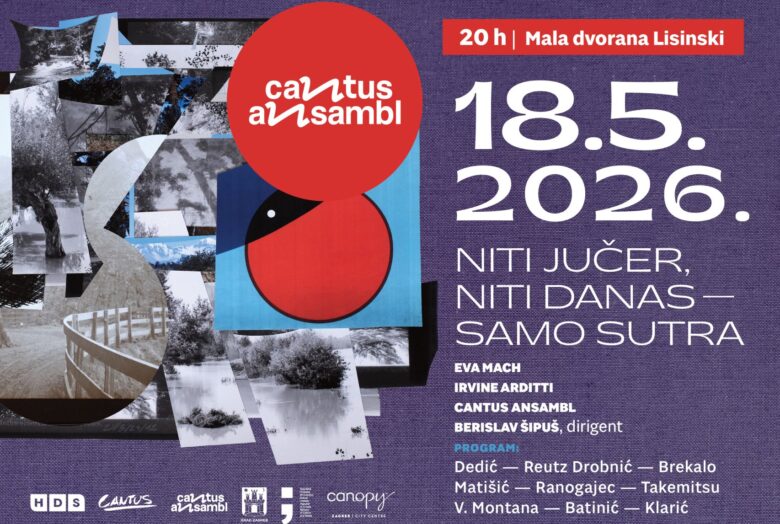
The sixth concert of the Cantus Ensemble cycle in the 2025/2026 season, entitled Neither Yesterday, Nor Today – Only Tomorrow, brings an evening of powerful authorial poetics, new soundscapes and as many as seven premieres by Croatian composers of different generations and aesthetic orientations. The concert will take place on Monday, May 18, 2026 at 8 p.m. in the Vatroslav Lisinski Small Hall, conducted by Berislav Šipuš, with the Cantus Ensemble and soloists — violinist Eva Mach and the legendary Irvine Arditti, one of the most important interpreters of contemporary music of our time.
The concert program consists mostly of new works by young composers whose scores were selected at the Ensemble’s First Public Call announced in August 2025. Among the registered authors, who could submit up to two compositions created after January 1, 2020, the committee consisting of Berislav Šipuš, Ivan Josip Skender, Danijel Martinović, Helena Skljarov and Juraj Marko Žerovnik selected a total of seven compositions for performance at this concert. Among them are six new works by composers Tihomir Ranogajac, Šimun Matišić, Matko Brekalo, Lukša Vučić Montana, Krešimir Klarić and David Batinić, as well as a composition from 2023 by Veronika Reutz Drobnić. In addition to encouraging young people, the Cantus Ensemble also encouraged the creation of a new piece for solo violin by Srđan Dedić, who conceived and dedicated his composition Heat of the Night to Irvine Arditti, the resident guest soloist and concert master of the Cantus Ensemble in 2026.
The evening opens with the premiere of the composition Heat of the Night by Srđan Dedić, composed specifically for Irvine Arditti. Inspired by the virtuosity and stage energy of the legendary violinist, the composition combines eruptive gestures and contemplative episodes into a musical space of “the excitement of the night”.
In Veronika Reutz Drobnić’s Three Thoughts on Folk Music, Croatian traditional music becomes the starting point for new sound narratives. The author does not reach for folklore as a quote or document, but transforms it into a contemporary sound organism that simultaneously evokes and transcends its origins.
A philosophical and almost metaphysical horizon is opened by Matko Brekalo’s Fractality Paradox — a composition that, through the idea of fractals and infinite complexity, contemplates the relationship between the finite and the infinite, human perception and natural laws. On the other hand, Šimun Matišić, in his new work Thalia, Calliope and Terpsichore Read Sappho, builds a layered musical dramaturgy inspired by fragments of Sappho’s poetry and ancient Greek drama, combining the principles of poetry, dance and theatre into a contemporary musical ritual, which will also have its premiere that evening.
The premiere of Tihomir Ranogajac‘s The Last Birdsong is inspired by a poignant recording of the last male of the extinct Hawaiian bird Kauaʻi ʻōʻō. Between an homage to Olivier Messiaen and a meditation on disappearance, the piece shapes a fragile world of sonic destinies that appear, develop and disappear.
The second part of the concert brings the rarely performed Rocking Mirror Daybreak by the Japanese great Toru Takemitsu for two violins, interpreted by Irvine Arditti and Eva Mach. In this subtle and poetic work, silence becomes as important as sound, shaping the space of musical meditation through the Japanese concept of ma — the space between sounds, a time of silence and presence.
Another premiere that evening is the multimedia piece SENKŌ by Lukša V. Montana, created in collaboration with video artists Jana Pitalo and Tina Masnić. The composer explores the “flash” as a moment between perception and cognition. Through the gradual formation of sound layers and tensions, SENKŌ is formed into a suggestive audiovisual whole that is constantly changing and eludes final meaning.
Dreamy and fluid sound spaces are also brought by the premiere of Topographia Somnii by David Batinić — a kind of dream cartography in which musical events do not unfold according to the logic of the waking world, but through associative and intuitive transformations of textures and gestures.
The concert closes with a premiere of the composition Dissensio by Krešimir Klarić — a concerto for violin and chamber ensemble in which the relationship between the soloist and the ensemble develops through tensions, conflicts and gradual rapprochement. At the heart of the composition is the energy of conflict that is not resolved by victory, but by quiet disintegration and exhaustion.
The title of the last concert of the Cantus Ensemble season, Neither Yesterday, Nor Today – Only Tomorrow, sums up the spirit of this evening: a look towards music that is created now, but always seeks what is yet to come. The rest of this year, and therefore the beginning of the new season in the fall, remains in the celebratory attire of the ensemble, which does not give up on its qualities and clear artistic aspirations even after 25 years.
We cordially invite you to the Small Hall Lisinski on Monday, May 18, and you can get tickets for the concert HERE.
related news from Cantus Ensemble
You might be interested in...
URL je kopiran u međuspremnik