

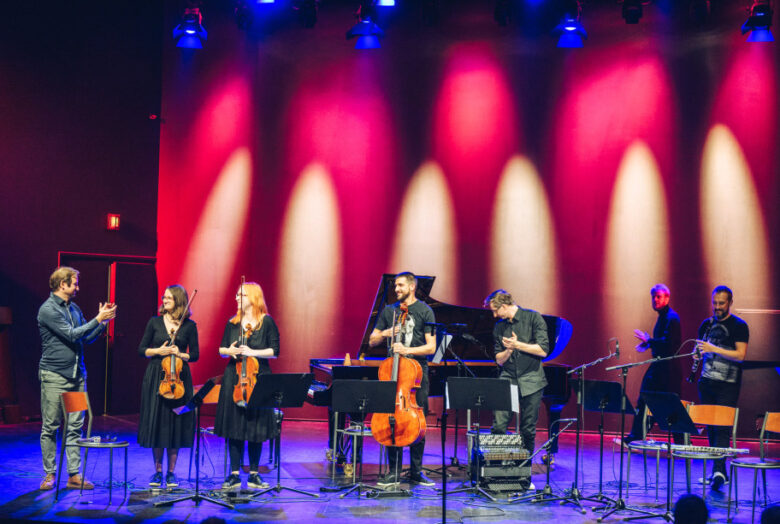
As Berislav Šipuš, speaking on behalf of the Cantus Ensemble, emphasized in his opening address, the ensemble’s current anniversary concert season — marking 25 years of successful activity and numerous artistic collaborations — is dedicated to those to whom, in his words, “we owe much good new music.”
True to its long-standing operational model, collaboration remains the foundation of Cantus Ensemble’s artistic identity — a potent basis for exchange, new creation, and dialogue between diverse cultural and artistic contexts.
Thus, the honor of inaugurating the celebratory season on 13 October, with a concert titled Young Polish New Music in the Small Hall of Vatroslav Lisinski, was entrusted to Warsaw’s Hashtag Ensemble — a group whose organizational philosophy reveals much about their collective dynamic, democratic principles, and open, flexible approach to creating music.
A Living Collective in Motion
A detailed and illuminating interview published just before the Zagreb concert provided an unusually direct insight into the ensemble’s inner workings: fluid roles, shared authorship, and constant rearrangement in pursuit of new forms of musical communication with the audience.
This collective modus operandi could easily be read as resonating with the philosophical ideas of Rosi Braidotti on the posthuman subject and collective dynamics. Within the context of an ensemble, such concepts materialize in daily practice — turning the group into a living organism that continually changes, learns, and evolves alongside its members and listeners.
Formed as a musical cooperative without a permanent leader, Hashtag Ensemble functions as an open creative collective — one that continually shifts, crossing and re-crossing its own operational boundaries. This free, collective, processual model aligns almost perfectly with what Braidotti calls nomadic subjectivity: a mode of being that is not rooted, but constantly becoming and redefining itself — existing within a web of relations among humans, technologies, nature, and sound.
Indeed, the Hashtag Ensemble’s concert in the Small Lisinski Hall unfolded as something open and transformative — like a living organism breathing with the space and the audience, and, perhaps more importantly, possessing both sense and substance in the messages it sought to convey.
As announced in their pre-concert interview, the thematic axis of the evening was the relationship between humanity and environment — the consequences of human decisions and the ways we live as a society. The program’s core was a cohesive and conceptually unified set of works by two Polish composers, one Puerto Rican composer, and a Croatian voice — Margareta Ferek-Petrić.
The Poetics of Nature, Matter, and Life Cycles
The nucleus of the program consisted of poetics that, while distinct, share a common imaginative space: that of nature, materiality, and the cyclical patterns of life. This subtle yet powerful continuity could be read as a vital line stretching from the strong and influential female voice of Kaija Saariaho — whose work was inspired by transtemporal natural phenomena — to the contemporary female voices gathered in this concert, who speak of nature and the natural through the lenses of social crisis, insecurity, ecological fragility, and posthumanist awareness.
From Capitalist Realism to Posthuman Fatigue
The evening was framed by two male composers — opening and closing the program.
Paweł Malinowski (1994) began with Paradise Blue (We’d Never Be Apart) (2020) for bass clarinet, accordion, and electronics — a gently disillusioned vision of the present, shot through with the anxieties of capitalist realism. Through irony and estrangement, Malinowski offers a critical reflection on the illusions of progress and technology.
After this ‘prologue,’ in which matter itself seemed to awaken, came Angélica Negrón’s (1981) Dust (2015), for flute, clarinet, violin, cello, and recorded electronics — a musical landscape of life after catastrophe. The electronics, resembling female voices, open a space of melancholy and pain, while the acoustic instruments communicate beyond gesture and motif.
There is no dramatic arc here — only breath, the weight of air, and a faint yet perceptible glimmer of hope that, as Negrón suggests, “might, just might, signify the beginning of something new.”
Margareta Ferek-Petrić (1982), in her Climate Burn-Out (2018) for flute, clarinet, cello, and piano, turns the focus to time — its transience and exhaustion. Between Nietzschean ideas of destruction, death, banality, and boredom, and parodied musical clichés — a lazily ticking metronome, a chanson-like clarinet line, grotesque details — emerges an image of a world turning on its axis, yet drained of the power to change.
This concept aligns neatly with Braidotti’s notion of posthuman fatigue, in which crisis is not only ecological or social but existential: the world is depleted, and so are we — trapped in cycles of repetition and melancholic stagnation. Through fragmented instrumental voices and grotesque intrusions, the composition articulates this same exhaustion of the posthuman subject, demonstrating how music can both reflect and interrogate the fatigue of the world — and our place within it.
Sound as Substance
In Coal (2020) by Aleksandra Kaca (1991), for flute, clarinet, violin, cello, sampler, and live electronics — inspired by Franz Kline’s black-and-white painting Mahoning, which abstracts Pennsylvania’s mining legacy — life reemerges through matter itself. Electronics and acoustic instruments merge to the point of indistinguishability; what we hear no longer corresponds to what we see, or to what we expect sound to signify.
Sound becomes substance, line, gesture — almost a painterly stroke in space. Repetitive upward and downward motives evoke geological strata, the Earth’s very pulse. In this encounter of technology and corporeality lies what Braidotti terms vital materialism: the awareness that all things — stone, voice, algorithm — participate in the same circulation of life, that the entire universe may be conceived as an “infinite and indivisible matter” (Shaw 2015).
From Bees to Electromagnetic Fields
The evening’s most explicit biological layer came from Agata Zemla (1994) with her electroacoustic work To Bee or Not to Bee (2021) for flute, clarinet, viola, cello, and electronics. The electronic “swarm of bees,” spatially moving through the hall, evoked a microcosm of biological existence — the cycle from egg to death.
Playful yet apocalyptic, the piece renders the bee as a symbol of existence itself: a pollinator, mediator, guardian of balance. Without it, the world disappears — making the alternate title To Bee or Not to Be hardly inappropriate.
As a counterpoint to this organic thread, the final work of the evening, Wojciech Błażejczyk’s (1981) Aether (2020), for ensemble, electromagnetic waves, and live electronics, opened a window onto the electromagnetic realm — the inaudible waves saturating our urban environments. A landscape without humans, populated only by nonliving forests of signals and radiation, where beings no longer exist, only the continuous circulation of energy.
Music as a Space for Open Listening
Through Hashtag Ensemble’s non-hierarchical and collective approach, the concert revealed how contemporary music can serve as a space for subtle inquiry and open listening, without the need for overt messages or conclusions.
Even this dystopian vision ultimately belonged to the same map: humans, nature, and technology in perpetual transformation — sharing a nomadic journey through the space of sound, driven by the same impulse toward renewal and survival.
The Zagreb audience was thus treated to a thoughtfully conceived concert experience in which ideas, sound, and performance coexisted in rare harmony — and for that, it can be genuinely grateful.
Report by Martina Bratić has originally published by glazba.hr
Photo: Vedran Metelko
related news from Cantus Ensemble
You might be interested in...
URL je kopiran u međuspremnik