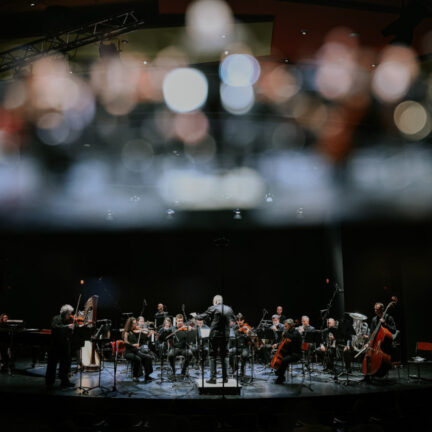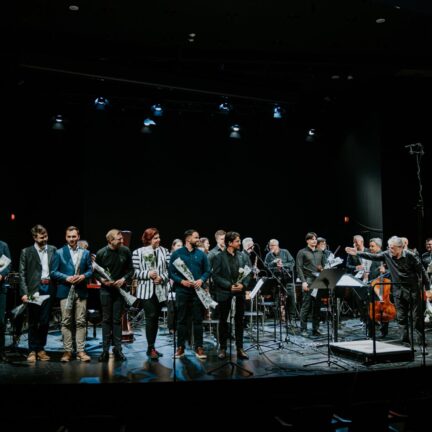
Having held its first concert two and a half decades ago as part of the 21st Music Biennale Zagreb, the Cantus Ensemble laid a solid foundation for the growth and development of the contemporary music scene in Croatia, enriching Zagreb's concert life with fresh performances of 20th and 21st century music, by both Croatian and foreign composers.
Its mission of "researching, discovering and presenting new and previously unexplored spheres of New Music", the Cantus Ensemble, under the artistic direction of the dedicated promoter of contemporary musical expression, composer, conductor and pedagogue Berislav Šipuš, has complemented its own cycle in the Small Hall Lisinski with a series of successful guest appearances and notable international collaborations since its very beginning.
The fifth concert of the Cantus Ensemble this season, held on April 27th, entitled Musica degli amici (Music of Friends), was also on the same track, entirely focused on collaboration and friendship with representatives of the contemporary Italian music scene – composers and musicians, who, together with the members of the Ensemble, under the convincing leadership of Berislav Šipuš, have achieved a special synergy. In its anniversary year, in which it recalls the impressive collaborations with composers and musicians achieved over the past two and a half decades, the Cantus Ensemble can boast of collaborating with the legendary violinist Irvine Arditti as concert master, whose essence of work is precisely his dedication to contemporary musical literature.
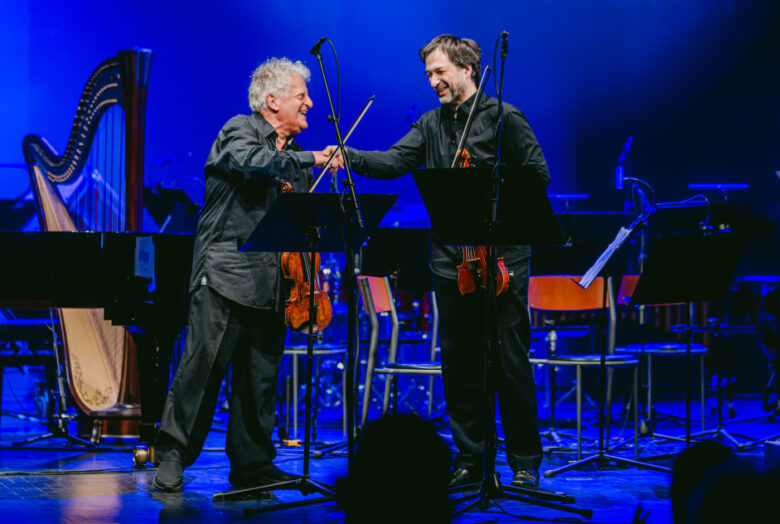
The extensive and demanding concert evening on that occasion was filled with works by Italian composers Rocco Abate, Giacomo Manzoni, Marcello Filotei, Cesare Valentini, Nicole Sani, Giampaolo Corali and Gaia Aloisi, of which the compositions of the latter two were premieres. The Italian connection was briefly interrupted by a surprise performance by violinists Irvine Arditti and Martin Draušnik, performing Gran Cadenza, for two violins by award-winning Korean composer Unsuk Chin. Commissioned in 2018 by the distinguished violinist Anne-Sophie Mutter, the piece reflects a demonstration of virtuosity and contrasting interaction between the soloists, ranging from confrontation, through dialogue, to flowing harmony, which Irvine Arditti and Martin Draušnik fully embodied.
We were introduced to an inventive concert evening by a performance of Ombra, for wind quintet by Rocco Abate, an experienced Italian composer, flautist and pedagogue, commissioned by the Zagreb Wind Ensemble, which premiered it at the 27th Zagreb Music Biennale in 2013. According to the composer, the Shadow in the title represents a compositional process, while simultaneously referring to the unconscious part of the personality. The members of the Cantus Ensemble, flutist Ana Batinica, oboist Dario Golčić, clarinetist Danijel Martinović, bassoonist Žarko Perišić and hornist Bánk Harkay devotedly shaped five questioning movements of the composition with the significant titles: Obsessions, Motometries, Barbaric, Consequences and Absences.
This was followed by an inspired performance of the composition Grave, for soprano and seven instruments by the Italian composer, music critic and pedagogue of the older generation, Giacomo Manzoni. The ode to the composer's friend and long-time collaborator Luigi Pestalozzi was composed in 2017, shortly after his death, and he chose as a template the poem Night Message by Albrecht Haushofer, which he wrote during his imprisonment, on the eve of his execution in 1945. The intimate, ominous character of the composition was convincingly woven, in collaboration with the members of the Ensemble, by the distinguished soprano Darija Auguštan, delighting the audience with the crystalline color of her voice and skillful shaping of demanding melodic arcs.
The attractive composition Sicut, for the chamber ensemble of Marcello Filotei, a long-time collaborator and friend of the Cantus Ensemble and Berislav Šipuš, was created specifically for Cantus, which premiered it in 2024, on the occasion of the celebration of the Croatian Parliament Day in Rome. Reminiscent of the work of Giovanni Pierluigi da Palestrina and human aspirations, Filotei explores countless possibilities for transferring the theme from section to section, with a prominent role for the piano, performed by Srebrenka Poljak, and appealing moments of improvisation and freedom, which despite everything are kept within limits by the conductor.
At the end of the first part of the concert evening, the Cantus Ensemble was joined by a versatile artist with a rich biography, flutist and composer Roberto Fabbriciani, who confidently performed the challenging solo section of the concerto for flute and ensemble, Cesare Valentini's Concerto di Zagreb. The renowned Italian composer wrote the concerto at the request of the Cantus Ensemble in 2018, which, together with Fabbriciani, who was also responsible for this collaboration, premiered it in December 2019. Known as a skillful explorer of the flute's numerous possibilities, Roberto Fabbriciani once again demonstrated his exceptional skill in shaping a wide spectrum of tonal colors, while at the same time presenting the flute as a humane means of communication.
The second part of the concert, after the previously mentioned surprise performance, brought the atmospheric composition The Night After the Clouds, for three bass flutes, digital sound synthesis and live electronics by Nicole Sani, in an impressive, almost meditatively considered performance by Roberto Fabbriciani, Ana Batinica and Ivana Vukojević Medvidović, with live electronics by Luca Richelli. The composition, which ingeniously blends the mysterious sonority of the bass flute and digital technology, was premiered in December 2019 by Ana Batinica and Roberto Fabbriciani with former Cantus Ensemble member, the recently deceased Dani Bošnjak.
The first premiere of the evening was that of the composition Intavolature, for two quintets by Giampaolo Coral, who died in 2011. Composed back in 1970, with a demanding notation that evokes Renaissance and early Baroque writing, Coral's composition simultaneously reflects his exploratory tendencies. The members of the Cantus Ensemble (wind and string quintet) presented this challenging work by skillfully building contrasting dynamic events and dense layers of its texture.
The end of the concert, which took place entirely in a friendly, warm atmosphere, was marked by the premiere of the concerto for violin and chamber ensemble, Ventre, by the Italian composer and vocal artist Gaia Aloisi, who met Maestro Šipuš at the international composition competition in Palmanova, where he chaired the jury. The soloist in the work, which skillfully and inventively examines the development, movement and transformation of sound, moving through its four connected parts from singing to noise, was the excellent violinist Sara Mazzarotto. With her enviable playing skills, exploration of the sound possibilities and tonal nuances of the violin within the framework of demanding musical content, with the exceptionally dedicated members of the Cantus Ensemble under the enthusiastic leadership of Berislav Šipuš, the musician achieved a vivid, convincing performance that will undoubtedly be remembered.
related news from Cantus Ensemble