

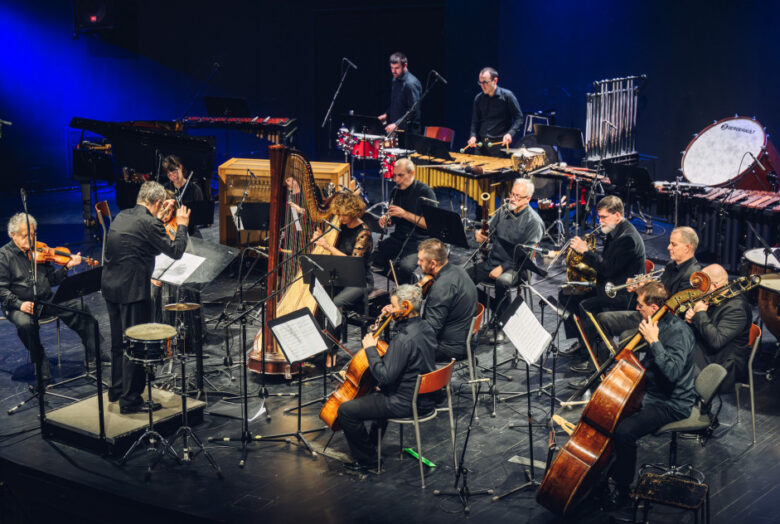
Alea iacta est! So it was at their beginning. A quarter of a century ago. They cast the dice without knowing which way it would turn. And yet the dice, propelled by some inner inertia and necessity, continued to roll for the next twenty-five years. This evening, admittedly, it was not a dice but a pair of drumsticks that were thrown. The effect, however, was no less striking. Like a glove hurled at the feet of one’s opponent in some bygone age, a challenge to a duel. That call to response—to reply, to dialogue, to pose new questions, to confront, to coexist—has been issued by the Cantus Ensemble for twenty-five years, addressed equally to the profession and to audiences, offering them a platform for the systematic and continuous generation of experience in contemporary art music.
“Contemporary,” of course, in a broad sense: encompassing the now extensive temporal span of the twentieth and twenty-first centuries, and an even broader spectrum of globally dispersed compositional poetics and stylistic tendencies.
The evening in question ceremoniously opened the year in which the Cantus Ensemble marks twenty-five years of existence and activity. Although it was already the third concert of Cantus’s regular season in the Small Hall of the Vatroslav Lisinski Concert Hall, 2 February 2026 signalled the Year of Celebration – The Beginning, as the concert’s symbolic title proclaimed.
The Idea of a Beginning
Symbolism permeated the programme on several levels. The idea of a “beginning” was reflected in a selection focused on Croatian composers—those whom Cantus gladly remembers, regularly collaborates with, and frequently performs.
Indirectly—or perhaps not so indirectly—the name that resonated throughout most of the evening was that of Stanko Horvat, represented by one of his distinctive and highly esteemed works. Yet Horvat, as professor, mentor, and teacher, permeated the biographies of most of the other composers on the programme, all of them former students of his composition class at the Zagreb Academy of Music: Frano Parać, Berislav Šipuš, Srećko Bradić, Srđan Dedić, and Sanda Majurec. This pedagogical thread running quietly beneath the surface of the concert felt like a tribute to Stanko Horvat, a towering figure in Croatian contemporary music, whose twentieth anniversary of death falls in 2026.
Two additional composers established links to the past: Krešimir Seletković to his teacher Davorin Kempf, and Ruben Radica to Milko Kelemen, the founder of the Zagreb Music Biennale—within whose framework the idea of launching the Cantus Ensemble was first conceived.
In keeping with the ideas that have guided Cantus since its inception, this concert reaffirmed the Ensemble’s principal mission: to cultivate the memory of iconic names and representative works of Croatian contemporary music, while simultaneously encouraging the creation of new works. Indeed, the evening featured the world premiere of a new composition by Krešimir Seletković—seeking, even within the new, to probe further, to shift perspectives, and to question reality.
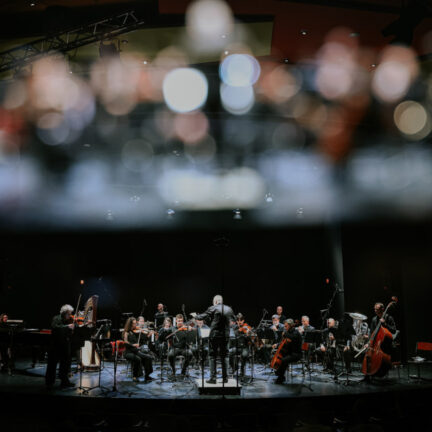
The Ensemble’s performing forces have always been flexible and instrumentally diverse, appearing in smaller or larger formations, led by experienced core members and open to the influx of younger generations. This has long been its hallmark, and likely one of the reasons for its endurance over a quarter of a century. On this evening, as on so many others, it could present solo and ensemble performances alike: bring a harp onto the stage, deploy a broad spectrum of percussion, reinforce the wind section, showcase an outstanding instrumental soloist from its own ranks, welcome a distinguished mezzo-soprano who has been part of its collaborative circle for decades, or offer the stage to a bass-baritone talent shaping his artistic path.
Finally, the idea of “beginning” was embodied in the newly launched collaboration with guest violinist Irvine Arditti, appointed Resident Guest Soloist and Concertmaster of the Cantus Ensemble for the anniversary year 2026. His appearance at the previous concert had already foreshadowed this partnership; now the residency officially commenced—one certain to offer Cantus musicians invaluable interpretative perspectives on the repertoire.
A Continuous Dialogue
The Year of Celebration opened with the only female composer on the programme: Sanda Majurec. A chamber formation of the Ensemble performed her I ritorni za for flute, clarinet, violin, cello, and piano, in an engaged interpretation under the conducting of Berislav Šipuš, with Ana Kovačev, Danijel Martinović, Eva Mach, Jasen Chelfi, and Srebrenka Poljak.
This was followed by Stanko Horvat’s Silazak na vrh (Descent to the Summit), performed by the Cantus Ensemble with mezzo-soprano Martina Gojčeta Silić. The work itself carries layers of symbolism: it was Horvat’s final composition, left unfinished in its version for voice and chamber ensemble. Stepping into his teacher’s shoes, Berislav Šipuš completed two songs based on Horvat’s sketches and independently orchestrated the final four. The posthumous premiere belonged to the Cantus Ensemble and Martina Gojčeta Silić.
This final, intricately interwoven work returned on this concert to mark a “beginning.” Yet returning to beginnings is nothing new for Cantus; it is one of the Ensemble’s—indeed Šipuš’s, as artistic director—core principles: to maintain a continuous dialogue with composers whose oeuvres have shaped the musical culture of this region.
In addition to his other roles, Berislav Šipuš appeared as composer. His solo violin piece Il piccolo catalogo dei sospiri was performed by Irvine Arditti, who suggestively shaped a performative whole from Šipuš’s motivic sighs. Srđan Dedić’s three-movement Ich vergesse Dich nicht brought a larger ensemble back to the stage. Dedicated to the Cantus Ensemble, the work has been performed by them in Croatia, Austria, Canada, and China.
Memories and Meaningful Nonsense
The second half opened with Frano Parać’s Memorie for voice and chamber ensemble, once again featuring Martina Gojčeta Silić as soloist. In contrast to Horvat’s intimate sketches—requiring expressive, sometimes forceful, sometimes subtle vocal projection—Parać’s musical memories are imbued with a more melodic vocal approach and evoke a Mediterranean sensibility that frequently underpins his compositional voice. Both approaches are equally close to the experienced mezzo-soprano.
Next came Srećko Bradić’s Concerto for Flute and Chamber Ensemble, first performed in Zagreb within the Cantus cycle in 2013, with Dani Bošnjak as soloist. This evening, Ana Batinica confidently and impeccably assumed the solo role. Unbeknownst to those present, the day after Cantus’s anniversary beginning—3 February 2026—the Croatian musical and cultural public would bid farewell to Dani Bošnjak, an exceptional musician who had woven himself into every fibre of Croatian musical creation and performance.
As the evening approached its conclusion, it was time for something new. Krešimir Seletković’s Lorem ipsum, premiered by bass-baritone Toni Nežić with the Cantus Ensemble, emerged from an experiment—and ultimately became one itself. Seletković playfully manipulates a textual template generated through publicly available translation services. This pseudo-text, already a distortion of Latin, is run through “translators” into Croatian—or first into English, then into Croatian—before the composer rearranges and reshapes the resulting variants into a new dramaturgical trajectory. In short, it journeys from nonsense to meaning, which in turn becomes a new nonsense.
The music follows this journey through varied compositional gestures, often inclining toward a form of tone painting that heightens the grotesque character of the work. Within this compositionally crafted absurdity, the performers navigated deftly, while Toni Nežić demonstrated a serious and nuanced vocal approach. The final punctuation mark belonged to conductor Šipuš, whose few strokes on the snare drum ended with the sticks almost protestingly cast onto the floor of the front row.
The concert might well have ended there—with that symbolic glove thrown at the audience’s face—had the Cantus Ensemble not chosen to offer a concluding gesture. Ruben Radica’s Litanies of All Saints for Pope John Paul II – 72 Invocations for Chamber Ensemble, dedicated to the Cantus Ensemble and premiered in 2006 at the Osor Musical Evenings, brought the evening full circle. The instrumental ensemble was enriched by the harp part performed by Mirjana Krišković, and Radica’s reconciliation of complexity and simplicity in compositional and sonic texture encapsulated Cantus’s mission: to present the diversity of Croatian composers who have left a distinctive imprint on the Ensemble’s history.
Do we accept the glove that has been thrown? We shall see at the close of this anniversary year. Or perhaps in another twenty-five years’ time.
The text by Mirta Špoljarić was republished from the portal Glazba.hr.
Photo: Vedran Metelko
related news from Cantus Ensemble
You might be interested in...
URL je kopiran u međuspremnik