

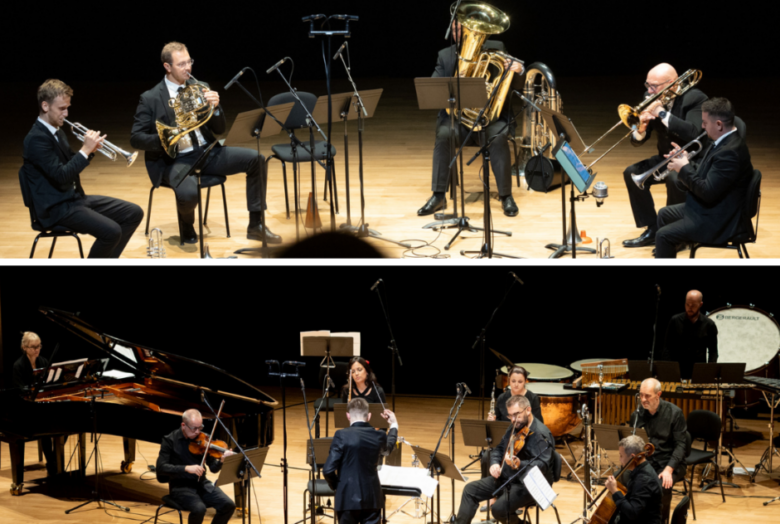
CANTUS ENSEMBLE AND ZAGREB PHILHARMONIC BRASS AT THE 63RD MUSIC TRIBUNE IN OSIJEK
The 63rd edition of the Croatian Composers’ Society’s Music Panel, held from November 23 to 25 at the Cultural Centre in Osijek, featured three days of intensive programming. It served as a focal point for encounters among composers, musicians, multimedia and visual artists, musicologists, educators, students, and enthusiasts of contemporary musical expression. The event offered yet another opportunity to gain new insights and exchange existing experiences through a series of concerts, panel discussions, a workshop, and a lecture—all curated by artistic director Tibor Szirovicza and the program committee, consisting of Sanda Majurec, Jana Haluza, and Ivan Božičević. The diverse concert program provided an overview of Croatian chamber music, as well as works for soloists, choirs, and audiovisual media. Following performances by guitarist Krešimir Bedek, the Brevis Vocal Ensemble, saxophonist Lovro Merčep, and the duo of tubist Krunoslav Babić and pianist Mija Elezović, the central evening slot on Saturday was dedicated to a concert by the Cantus Ensemble, conducted by Stjepan Vuger.
The Cantus Ensemble’s Anniversary Year
In the year marking its 25th anniversary, the Cantus Ensemble—in addition to its regular concert series at the Vatroslav Lisinski Concert Hall’s Small Hall—will hold a gala concert in December as part of the “Lisinski Saturdays” series. Furthermore, the Music Panel in Osijek served as another valuable occasion to reflect on the ensemble’s sustained promotion of contemporary musical creation, with a particular focus on Croatian works. The Cantus Ensemble is, in fact, one of the most significant contributors to the development of the contemporary music scene in Croatia; for many years, under the artistic leadership of conductor Berislav Šipuš and with resident conductor Ivan Josip Skender, it has engaged in successful international guest performances and collaborations.
The Cantus Ensemble’s concert on Saturday, October 24, at the Franjo Krežma Concert Hall in Osijek was conducted by Stjepan Vuger. Through an understated yet compelling conducting style, he fostered a harmonious collaboration with the ensemble members: violinists Ivan Novinc and Eleonora Hil, violist Tvrtko Pavlin, cellist Jasen Chelfi, flautist Ana Batinica, oboist Iva Ledenko, clarinetist Danijel Martinović, percussionists Marko Mihajlović and Francesco Mazzoleni, and pianist Srebrenka Poljak. The program featured works by Croatian composers from various generations—Ante Knešaurek, Sanja Drakulić, David Batinić, Vigo Kovačić, Luka Rovis, and Lovro Žagar—into which an inventive piece by the Italian composer Giovanni Verrando fit perfectly.
The evening opened with O jednom trenutku usamljenosti (On a Moment of Loneliness)—a work for flute, oboe, clarinet, violin, viola, cello, and percussion by Ante Knešaurek—which was premiered by Ensemble Recherche at the 55th Music Panel in Opatija on November 8, 2018, as part of their concert project Lovesongs – Liebeslieder. Ante Knešaurek’s recent compositions reflect his contemplations on events, moods, and specific life situations within various stages of the human experience; O jednom trenutku usamljenosti is one such work. Imbued with a melancholic, wistful atmosphere—skillfully brought to life through the polished performance of the Cantus Ensemble—Knešaurek’s piece mirrors introspective thoughts and a sense of helplessness in a moment of solitude, while simultaneously confronting that state with courage.
Also dedicated to Ensemble Recherche is Retrouve—a single-movement work for flute, oboe, clarinet, violin, viola, cello, and percussion by Sanja Drakulić. Structured as a series of miniatures, it was premiered at the same concert as the aforementioned piece. The members of the Cantus Ensemble, under the direction of Stjepan Vuger, delivered a compelling and evocative performance of this inventive, coloristically rich musical depiction—a portrayal of the search for love, the act of finding it, and the (un)expected nature of its outcome—while skillfully navigating the vivid spectrum of colors inherent in the musical content.
David Batinić’s ingenious compositional voice is reflected in his work Topographia Somnii for chamber ensemble. According to the composer, the piece “stems from the concept of a dream as a realm of altered perception and an internal, often elusive logic—a space where scenes, relationships, and the flow of time do not follow the laws of the waking state, but rather associative and intuitive principles. In this sense, the composition seeks to shape its own dramaturgy as a kind of ‘cartography’ of the dream experience—a fluid space in which musical events are in a constant state of transformation and overlap.” Built upon contrasting sonorities and a shifting character, the work’s musical material evolves toward an increasingly layered and dense texture, all while maintaining a sense of continuous flow.
The work of the prominent Italian composer and educator Giovanni Verrando was represented by his 1995 piece for small ensemble, Quattro Invenzioni sull’Offerta Musicale (Four Inventions on The Musical Offering). This is an early, four-movement work by the composer, commissioned by the Teatro Comunale in Bologna, which is based on the initial musical material from Johann Sebastian Bach’s Musical Offering. Four contrasting inventions present musical content derived from distinct concepts; their transformation was meticulously shaped by members of the Cantus Ensemble, guided by the careful gestures of Stjepan Vuger.
As part of an Erasmus+ mobility project in Milan—and under the guidance of Giovanni Verrando—the piece Echoes of the Dead Tribe was composed for piano, violin, and cello by Vigo Kovačić. Kovačić is a composition student at the Zagreb Academy of Music in the class of Professor Berislav Šipuš, and he also represents the youngest generation of composers featured at this year’s Music Panel. Prompted by an initiative from the Milan-based ensemble Syntax, Vigo Kovačić created a work in which the “starting idea was to blend the sonic identities of all three instruments—the strings and the piano—as thoroughly as possible. In the process of realizing this idea, a sound emerged that increasingly reminded me of the muffled echoes of long-forgotten ancient tribes—evoking not only their percussion, rhythms, singing, dancing, calls, and breathing, but also the profound silence left in the wake of their disappearance.” Through their understated performance, members of the Cantus Ensemble—pianist Srebrenka Poljak, violinist Ivan Novinc, and cellist Jasen Chelfi—brought to life the ethereal atmosphere of this piece, which was selected through a competition for the 63rd Music Tribune. Next came another work selected through the competition: Ryvako, a piece for piano trio by Pula-based composer Luka Rovis. Composed in 2026 at the instigation of Trio Kamov—who also gave its premiere in Chile—the work is built upon a series of intervals derived from the Istrian scale, presented here in a reordered sequence. It features striking, powerful contrasts, both in its musical material and in its overall dramatic structure.
The Cantus Ensemble’s concert concluded with porcelain, a work for chamber ensemble by Lovro Žagar—another representative of the youngest generation of composers and a student of Academician Srećko Bradić at the Zagreb Academy of Music. This piece, also selected via the competition for the 63rd Music Tribune in Osijek, “explores the fragility and fragmentation of musical material,” according to the composer, “portraying the irreversible fractures that violence, exploitation, and control leave upon individuals and their relationships.” Abstract gestures and extended techniques—interspersed with faint traces of a recognizable melodic and harmonic language—predominate in this thoughtful work, through which the Cantus Ensemble and conductor Stjepan Vuger brought their guest appearance in Osijek to a close with both success and a spirit of exploration. Following the Cantus Ensemble concert, a program titled Compositions in the Audiovisual Medium—held in the Small Hall of the Osijek Cultural Center—successfully showcased audiovisual works by Srđan Dedić (Time Scales-Pitch Scales, an algorithmic composition for synthesizers with a graphic score), Mladen Milićević (Etides of Frustration, for electronics and video), Tomo Bedalov (Cubed Sax, for baritone saxophone, tape, and video, featuring saxophonist Martin Zdelar), Pietro Dossena (Drift, for clarinet, live electronics, and live visuals), and Ivan Božičević (Organic Steam, for computer-controlled organ and video).
A Fresh Conclusion to the Music Tribune with the Zagreb Philharmonic Brass
The final concert of the 63rd Music Tribune took place on Sunday, October 25, at noon, in the Franjo Krežma Concert Hall at the Osijek Cultural Center, featuring the Zagreb Philharmonic Brass.
This brass ensemble consists of five soloists from the Zagreb Philharmonic—trumpeters Mario Lončar and Peter Firšt, horn player Yevhen Churikov, trombonist Mario Šincek, and tubist Krunoslav Babić—joined by Luka Buljan, principal trumpet of the Croatian National Theatre Opera Orchestra in Zagreb. As the musicians themselves noted, playing together in this ensemble offers a departure from their daily orchestral duties and presents a unique challenge; indeed, a sense of freshness and enthusiasm permeated their performances throughout the entire concert. The concert opened with the premiere of a work selected through a competition for the 63rd Music Tribune: Pidgeon in distress causing a mess, flying through the White House, a piece for brass quintet by Tin Ujević, a graduate in applied composition from the class of Professor Frano Đurović at the Zagreb Academy of Music. Born from a desire to explore the sonic potential of brass instruments—and how extended techniques might be integrated naturally into the musical flow—Ujević’s composition examines the expressive and technical possibilities of contemporary performance practices on brass instruments.
The inquisitive spirit of the ensemble members shone through once again in the next work on the program: Cascades and Chorales (Kaskade i korali) for brass ensemble by Ivan Končić. Composed in 2019 for the 30th Music Biennale Zagreb (MBZ)—which centered on the theme “Music – Space – City – Sound”—the piece draws inspiration from a comparison between the urban landscapes of Zagreb and Dubrovnik. Observing that the buildings in Dubrovnik seem to grow ever smaller—in contrast to the skyscrapers and expansive flat surfaces of Zagreb—Končić crafted a nostalgic work that yearns for the “irregularities” of his native region—the inclines and winding paths—all skillfully brought to life through the ensemble’s well-coordinated performance by the ensemble members. A sense of wistfulness and nostalgia is also reflected in the fact that the work serves as a final farewell to the composer’s professor, Željko Brkanović—who passed away in 2018—and embodies his artistic principles: from the use of contrasting materials and so-called orchestral “situations” to the concept of a chorale-like melody. The musicians of the ensemble convincingly conveyed the atmosphere of the piece, about which Ivan Končić writes, with the benefit of hindsight: “Today, in 2026, I find that I no longer notice the height of the buildings, yet I still miss the Professor.”
Frano Đurović’s Mrtva priroda (Still Life), composed for brass quintet in 2000, received its premiere a year later at the 38th International Music Tribune in Pula. Reflecting a spatial, “synesthetic” stillness—which, in the composer’s words, “lives, breathes, pulses, moves, possesses its own dynamics, and renews its own colors”—the work is based on a five-note mode. Its inventive musical content was brought to life with great insight by the members of the ensemble.
That same year (2000)—while studying under Professor Marko Ruždjak at the Zagreb Academy of Music—Ivana Kiš composed Boombrass, a set of seven miniatures for brass quintet. The work was subsequently premiered during a concert of student compositions at the 38th International Music Tribune in Pula. The Zagreb Philharmonic Brass approached the imaginative musical content of this piece—which the composer herself considers a turning point of inestimable value in her own musical and stylistic evolution—with a blend of playfulness and conviction, skillfully shaping the contrasting moods with which the work abounds.
Next came the Sextet for Three Trumpets, Horn, Trombone, and Tuba by Silvije Foretić—a three-movement work commissioned by the MBZ (Music Biennale Zagreb) in 2019 and premiered that same year by the ensemble Ad Gloriam Brass. The piece radiates a clear sense of the self-sufficiency of its musical content, infused with ingenious touches and virtuosic elements, as well as unexpected moments—such as pauses and theatrically staged “acted-out” segments in the third movement, Parlando, where the musicians wittily debate the composer’s intentions and the (im)possibility of performing their respective parts.
To conclude the Osijek concert—and, indeed, the 63rd Music Tribune itself—the Zagreb Philharmonic Brass performed Czardasz (1988), a piece for brass quintet by Ivo Josipović, originally premiered by the Volga Brass Quintet from Ulyanovsk. Within that portion of Ivo Josipović’s oeuvre dedicated to dances and folk customs, Czardasz stands out for its vivid musical material—rooted in traditional Hungarian folk dance and music—and its two-part structure. Working in dedicated collaboration, the Zagreb Philharmonic Brass meticulously crafted the melancholic atmosphere of the slow introduction (lassú) and the energetic, spirited mood of the second section (friss)—characterized by a striking rhythmic pulse—thereby conveying the verve of their collective music-making to the audience as well.
Text: Bojana Plećaš Kalebota
Photo: Dubravka Petrić
You might be interested in...

URL je kopiran u međuspremnik