

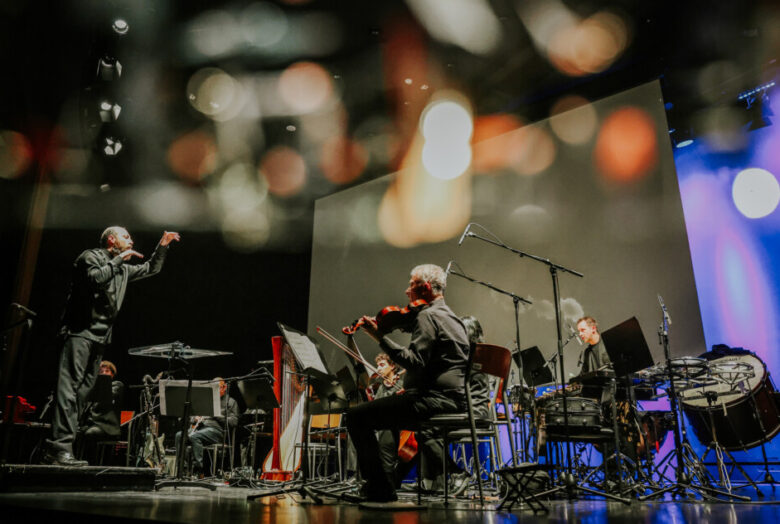
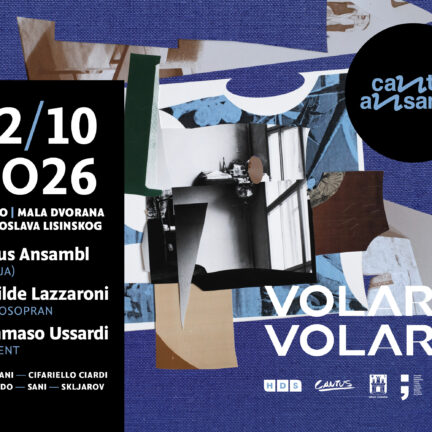
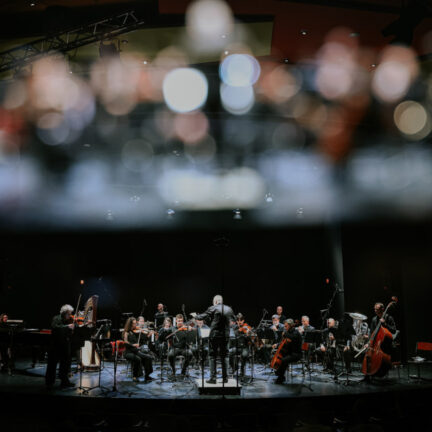
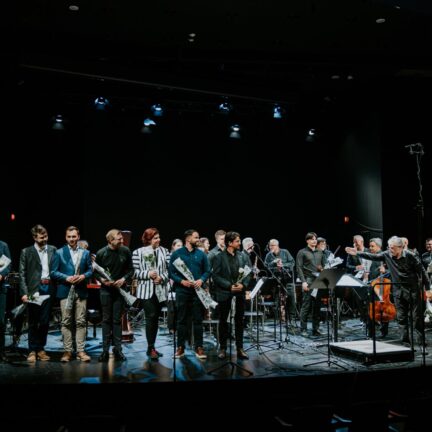
On Monday, October 12, the new season of the Cantus Ensemble began in the Lisinski Small Hall. This season marks the 25th anniversary of the ensemble, which specializes in the performance of contemporary music. The celebratory season opened with a guest appearance by the Italian group Ensemble Icarus—a long-time collaborator of Cantus, dating back to the latter’s inception in 2001. The program featured the premiere of a new composition by Helena Skljarov, alongside works by Italian composers—some already familiar to the Zagreb audience—including Paolo Perezzani, Fabio Cifariello Ciardi, Giovanni Verrando, and Nicola Sani. Mezzo-soprano Matilde Lazzaroni appeared as the soloist, with Tommaso Ussardi conducting.
Founded in 1994, Ensemble Icarus has spent over three decades performing at major cultural institutions and prestigious festivals throughout Italy. The group has also toured extensively across Europe, North and South America, Asia, and Egypt. Their collaborative work extends to other ensembles—including Cantus—as well as directors, actors, artists from various disciplines, and figures from the international electronic and post-techno scenes.
Composer and conductor Tommaso Ussardi (b. 1984) earned degrees in composition, orchestral conducting, and choral conducting in Bologna. He furthered his studies at the Accademia Chigiana under the guidance of Daniele Gatti. As a conductor, he has performed in leading Italian concert halls and theaters, presenting a diverse repertoire; however—as noted in the program booklet—his focus lies on the relationship between sound, gesture, dramaturgy, and perception, leading him to work primarily within the realm of contemporary performing arts. He is the founder, as well as the artistic and musical director, of the Orchestra Senzaspine, and serves as the musical director of Ensemble Instantanea, a group specializing in contemporary music.
Four compositional perspectives on the sound of the contemporary era
The Italian composers whose music was featured were born between 1955 and 1965; yet—with the exception of Giovanni Verrando’s Dulle Griet—the works presented were recent compositions, created within the last six years.
The program opened with Es muß sein! (2021) by Paolo Perezzani. The title is derived from the motto found in the final movement of Beethoven’s last string quartet (in F major, Op. 135), where Beethoven wrote: Muß es sein? – Es muß sein! (“Must it be? – It must be!”). Perezzani views this as an impulse from the past that, within his own creative process, opens up space for something new. Beyond this, there are no other connections to Beethoven in Perezzani’s music; the piece offers a wealth of sonic textures and brief motifs organized into smaller thematic units, which are punctuated by sharp, intrusive strikes from the percussion section. Ussardi and the Icarus Ensemble delivered a highly focused, musical, and compelling performance of this piece, as well as the other works on the program. Fabio Cifariello Ciardi (b. 1960) introduced himself to the Zagreb audience less than two years ago with the multimedia project Voci vicine—a socially engaged contemporary passion play that uses music and imagery to depict the anger of ordinary people: the impoverished, the unemployed, those struck by natural disasters—individuals whom the state forgets when they are in need of help. Ciardi maintains this commitment in his 2025 composition Hind, one of several works dedicated to the Palestinian girl Hind Rajab, who was killed by Israeli soldiers; her desperate pleas for help were captured in a tragic audio recording. For some time, Ciardi’s creative focus has centered on the instrumental transcription of speech and language—a technique he employs here as well, transcribing Hind’s voice and the sounds of destruction and collapse into the fabric of the instrumental music. The result is a chaotic, striking composition defined by sharp contrasts: lyrical violin solos set against the noisy, tumultuous soundscapes of the rest of the ensemble, further enhanced by theatrical elements.
Giovanni Verrando (b. 1965) is a composer and writer on music who studied philosophy and composition in Milan. He furthered his compositional training at the Accademia Chigiana and at IRCAM, where he studied under Tristan Murail. His works explore musical language, orchestration, electronics, non-standard instrumentation, and multimedia. He titled the composition Dulle Griet (Mad Griet)—written for ensemble and electronics—after the painting of the same name by Pieter Bruegel, in which Griet leads a group of women to plunder Hell, making their way through a landscape inhabited by monsters that symbolize sins. Much like Bruegel’s painting—filled with blurred contours and colors, where creatures seem to morph into one another—Verrando incorporates non-standard instruments into the score, while treating standard instruments with electronics to such an extent that their timbres become unrecognizable.
Nicola Sani (b. 1961) is a composer, media artist, manager, and journalist who studied under—among others—Karlheinz Stockhausen; alongside works for conventional ensembles, Sani creates both electronic and multimedia projects. Per incantamento was composed in 2020, inspired by Dante’s sonnet Guido, i’ vorrei che tu e Lapo ed io (“Guido, I wish that you, Lapo, and I”), in which the poet depicts the space between desire, friendship, and utopia. The verses are delivered by a mezzo-soprano, accompanied by digitally processed sounds from the ensemble and live electronics; the dynamics and timbre shift constantly in response to the acoustics of the performance space, crafting an evocative soundscape that hovers perpetually on the edge of tension, yet offers no ultimate resolution.
The Conflict Between the Natural and the Artificial
Helena Skljarov (b. 1993) is significantly younger than the other composers whose works were featured, and this generational gap was clearly perceptible during the concert. The musicians gave the premiere of her composition Phenomenon—written for ensemble, video, and electronics—which is dedicated to Icarus and takes water, as a natural element, as its point of departure.
In a recent interview with HDS, the composer said the following about Phenomenon: “The piece features a clear narrative—complete with on-screen subtitles—as well as distinct images and objects. Sentences about various phenomena, music, or water unfold in sequence. I use water—and, by extension, music—in a very direct and literal way, exploring extremes: absolute stillness and nature, contrasted with aggression and machinery. Together with the verbal elements, it all feels a bit like a bombardment of sensationalist headlines or the kind of disjointed scrolling we are constantly subjected to today. I have always believed that every work of art emerges in dialogue with the artist’s own current thoughts and perceptions; in this sense, this piece serves as yet another commentary on contemporary life.”
In the video, alongside the narration, we see soothing images of water in nature and the composer knitting, juxtaposed with shots of a washing machine—where water, having been brought into contact with a machine, moves in a noisy, aggressive fashion. These images are woven into an inseparable whole with music that is nearly tonal and rhythmically well-defined. Through constant collisions—between the idyllic and the turbulent, the human voice and electronics—the work offers a wry, bitingly humorous commentary on the conflict between the natural and the artificial.
Alenka Bobinsky’s report has been reproduced in full from the Glazba.hr portal.
You might be interested in...
URL je kopiran u međuspremnik