

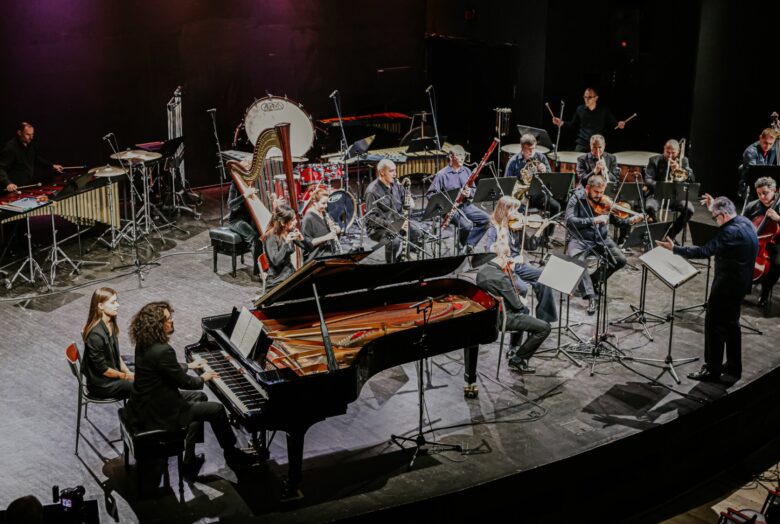
For nearly 25 years, Cantus Ensemble—a specialized and internationally active ensemble led artistically by Berislav Šipuš and with resident conductor Ivan Josip Skender—has been devoted to contemporary music in Croatia. As part of its regular concert series and the newly launched program titled “Un invitado en nuestra casa” (“A Guest in Our Home”), the ensemble is bringing to Zagreb the distinguished Argentine-Spanish composer and conductor Fabián Panisello, one of the prominent figures of the global contemporary music scene.
The fourth concert of Cantus Ensemble’s current season will be held on Monday, February 24, 2025, at 8:00 PM, in the Small Hall of the Vatroslav Lisinski Concert Hall. Under the baton of maestro Panisello, and with pianist Viktor Čižić as soloist, the audience will be treated to an intriguing mix of contemporary and historically inspired music—in a distinctly Spanish spirit, as suggested by the title of the concert.
A Meeting of Passion, Innovation, and Heritage
The program includes works by contemporary Spanish composers Jesús Torres, Mauricio Sotelo, and Fabián Panisello himself. Alongside these strong and individual artistic voices, the evening will also feature a piece by a composer essential to the entire canon of Spanish art music—Manuel de Falla. On this occasion, pianist Viktor Čižić will perform as soloist in de Falla’s rarely heard Concerto for Piano and Ensemble, a work that reflects the composer’s characteristic fusion of Spanish tradition and neoclassical aesthetic.
This concert evening is undoubtedly set to become a vibrant meeting of passion, innovation, and heritage—a dialogue between echoes of the past and the power and vitality of the present. Cantus Ensemble once again ensures the level of interpretation required to deliver a rich and rewarding listening experience.
Characteristic Contemporary Spanish Music
Ahead of the Zagreb concert, we spoke briefly with guest conductor Fabián Panisello, who is also the founder and artistic director of PluralEnsemble, one of Europe’s most prominent contemporary music groups. Throughout his career, Panisello has received numerous international awards and collaborated with leading contemporary composers and ensembles, including Pierre Boulez, Luciano Berio, Karlheinz Stockhausen, Susanna Mälkki, and Peter Eötvös, as well as orchestras like the BBC Symphony Orchestra, Deutsches Symphonie-Orchester Berlin, WDR Symphony Orchestra, Mozarteum Orchestra Salzburg, Ensemble Modern, and many others.
Zagreb’s concert has a distinctly Spanish imprint—from Manuel de Falla to today’s composers like Jesús Torres, Mauricio Sotelo, and yourself. How would you describe the connection between these works, and how do they reflect Spanish musical heritage through a contemporary lens?
All of these composers have a very vital relationship with music. I believe that Spanish composers, beyond technical exploration and innovation, have a natural tendency to infuse a certain emotional dimension into their approach. This concert is a good example of that and could be seen as very representative of our Spanish music of the 20th and 21st centuries.
Your Chamber Concerto for Ensemble is one of the central works on this program. How does it fit within your broader compositional output?
This piece was composed in 2005 and reflects my interest in assimilating different systems and heterogeneous elements within my work. In it, I explore a sort of “synthetic spectrum” from which I derive modal, pentatonic, and (tempered) spectral relationships. At that time, I was particularly interested in creating a form of neo-functionality through the use of contrasting harmonic systems.
You’ll be conducting the Cantus Ensemble, known for its contemporary repertoire. What is your impression of the ensemble, and have you worked with Croatian musicians before?
A year ago, I had the opportunity to work with Croatian horn player Radovan Vlatković, to whom I dedicated my Horn Concerto, and who performed it last year with the RTVE Spanish Radio Orchestra. This is my first time working with the esteemed Cantus Ensemble, and I am very much looking forward to our collaboration!
In his Concerto for Harpsichord and Ensemble, Manuel de Falla combines Spanish folk elements with neoclassical techniques. How did you approach interpreting this work, and what challenges does it pose for both the ensemble and the soloist?
This is a brilliant piece by Manuel de Falla in which, as you mentioned, he combines folk elements from different periods—especially the Renaissance, as seen in the citation of the song “De los álamos vengo…”—within a neoclassical and neobaroque sound world. The result is extraordinary but technically demanding for both the ensemble and the soloist.
Over your career, you’ve worked as a composer, conductor, and educator. How do you balance these three roles, and how do they influence one another?
These roles are deeply integrated into my musical life: my creative work in composition informs all other aspects of what I do. Teaching composition, analyzing new works, and studying scores for conducting are all part of a continuous, enriching musical process—and I couldn’t imagine working any other way.
Have you visited Zagreb before, and will you have time to explore or enjoy any particular spots during your stay?
I’ve only visited Zagreb once before, and briefly—but the city left a wonderful impression on me, especially its historic center!
related news from Cantus Ensemble
You might be interested in...
URL je kopiran u međuspremnik