

Twenty five years of
modern sound
The spark that lit the fire.
Throughout their twenty-five-year history, soloists, conductors, concert halls, festivals, continents, composers, scores, and artistic concepts have changed — but not the ensemble’s spiritual foundation: a deep commitment to the music of the 20th century and the ever-evolving 21st century.
Interestingly, the environment in which the Muzički biennale Zagreb (MBZ) was born — serving as Cantus Ensemble’s programmatic and conceptual nucleus — had never seriously considered establishing an institutionalized ensemble that would continuously sustain the festival’s unconventional and at times avant-garde pulse between biennial editions. Perhaps, amid the musical abundance of the 1980s, contemporary music on concert stages every two years seemed sufficient, while the war and post-war years left little room for such initiatives. But by 2001, the moment had arrived — the Biennale was approaching with a prepared repertoire, and Zagreb was filled with experienced (and young) musicians. Thus, a temporary resident ensemble was formed for the occasion, and the path toward adopting the name Cantus (Latin for “song”) proved remarkably short.
In truth, it was never truly “temporary” — its destiny had from the outset been one of permanence and continuity. The ensemble proved so compellingly accomplished that the spark of the MBZ quickly ignited a lasting flame. Their mission continued, and they persisted “...in an approach where presenting once-avant-garde music is not an end in itself, but rather the starting point for building interpretation” (Trpimir Matasović).
Identity and tradition
The ensemble was not born out of protest, defiance, or some adventurous impulse — it emerged simply out of necessity. It claimed a space without competition. It was, and remains, Croatia’s pioneering ensemble of its kind, commonly described as “an ensemble specialized in the performance of contemporary music.”
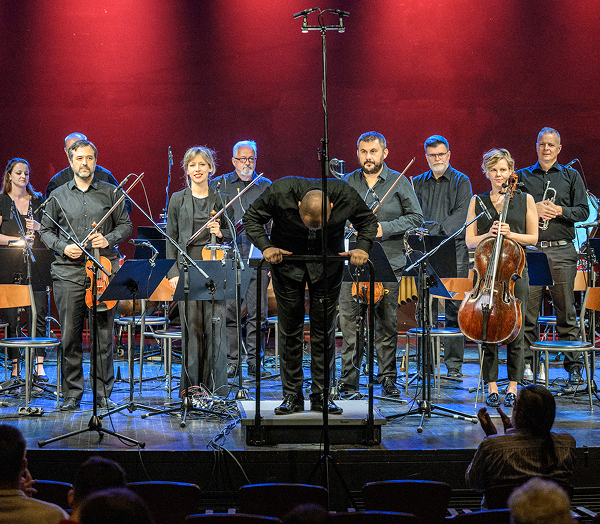
Making its debut at the Muzički biennale Zagreb in 2001 with a cycle of four concerts and ten world premieres, the ensemble charted a clear artistic direction both for itself and for a new generation of audiences. This vision further evolved in the 2006/2007 season through its own six-concert series (Cantus & Lisinski).
Its consistency has been sustained by its members — throughout all these years, the ensemble has performed in almost the same formation, built around two core five-member groups: strings and winds. Depending on the repertoire, the performing body expands or contracts, adapting to works that resist canonical ensemble formations and demand from musicians a multiplicity of interpretative roles — concert-based, and often theatrical as well.
The concert cycle that established the ensemble on the Croatian cultural scene became a genuine school of both the history and the present moment of New Music.
Today – the voice of contemporary music
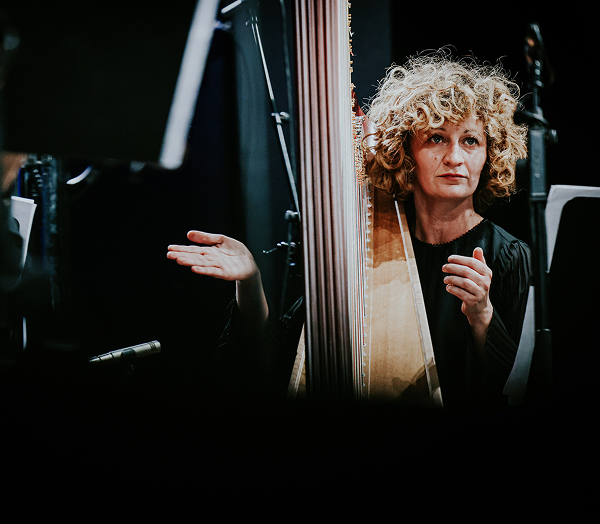
Cantus is an ensemble that combines individual excellence and collective strength. Its members are top instrumentalists, open to improvisation, experimentation and interdisciplinary projects. In doing so, they have shaped a new audience, ready to accept contemporary sound and its challenges.
With permanent conductor Ivan Josip Skender, the ensemble collaborates with numerous prominent Croatian and international artists. In twenty years of activity, they have presented around 600 opuses, premiered more than 100 compositions, and collaborated with almost all relevant Croatian composers.
Regardless of when a piece was created – from 1915 or 2015 – Cantus always presents it as fresh and current. Their work is best described by the quote from Horace: “Add sometimes a little madness to your intentions.”